Thermal Overload Relay: Working Principle, Diagram and Settings (Complete Guide 2026)
⚡ Quick Answer
A thermal overload relay is a protection device designed to protect electric motors against prolonged overloads. It works by heating internal bimetal strips which, in the event of excessive current, actuate a dry contact (95-96) to cut the power contactor coil, thus preventing the motor from being damaged.
⚠️ ELECTRICAL SAFETY: Before any intervention on a motor or a thermal overload relay, it is IMPERATIVE to work with the power off. Always perform a voltage absence check (VAC) with a certified device.

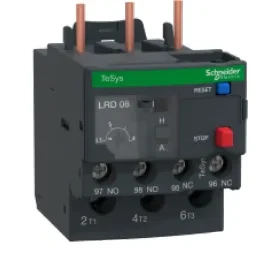
Schneider Electric LRD08 Thermal Overload Protection Relay (2.5-4A)
🛠️ The essential tool for this project.
THERMAL OVERLOAD RELAY OPERATION
What is the role of a thermal overload relay?
Its role is to detect overloads and inform the control section via opening or closing contacts.
Thermal overload relays are devices used to protect electrical installations against overloads. They protect downstream equipment, such as a three-phase motor. In this regard, also discover our complete guide to testing a three-phase motor with a multimeter to check its condition before installation.
Why does a thermal overload relay trip?
In the event of an overload, the thermal overload relay does not act directly on the power circuit. A contact of the thermal relay opens the control circuit of a contactor, and the contactor then cuts the power circuit.

THERMAL OVERLOAD RELAY TYPES
There are two types of thermal overload relays:
The first type is equipped with a bimetal electromechanical system. The heating of the bimetal strip occurs progressively and proportionally to the intensity of the overheating. Once tripped, the bimetal strip actuates a contact that informs the power contactor to cut the current. This system is not effective against short circuits due to its slowness.
The second type is electronic, where the bimetal strip has been replaced by an electronic device offering specific functions.
The thermal overload relay consists of two main parts:
- The power circuit.
- The motor control circuit.
What is the symbol for a thermal overload relay?

The power part is shown on the left and the control part on the right.

What criteria should be used to choose a thermal overload relay?
Choosing a thermal overload relay is based mainly on 4 elements:
• Operating voltage
• Operating current
• Setting range
• Starting time
DIAGRAM EXAMPLE

This diagram represents the starting of an asynchronous motor with 2 directions of rotation. The arrows indicate the position of the thermal overload relay and the various control contacts.
If motor M3 encounters an overheating problem, relay F1 will detect it and the bimetal strip will trip the internal contacts.
It will then cut the power circuit via the coils of contactors KM1 and MK2, and finally Indicator H1 will light up to indicate the fault.
Learn more about safety relays…
Why use a thermal overload relay?
The thermal overload relay is essential for protecting electric motors against prolonged overloads. It detects the temperature increase in the windings via bimetal strips and cuts the power before the motor suffers irreversible damage.
Where to place the thermal overload relay in a diagram?
In a power diagram, the thermal overload relay is generally placed directly below the contactor. Its control contacts (95-96) are inserted in series in the contactor’s control circuit to cut the coil in the event of a fault.
⚡ Thermal Overload Relay Setting Calculator
Estimate the rated current of your three-phase motor (400V).
⚖️ DISCLAIMER: This calculator provides a theoretical estimate based on standard efficiencies. The setting value (Ir) must be checked on your motor’s actual nameplate. Any intervention must be carried out by qualified personnel working with the power off. Electrotuto declines all responsibility for any material or physical damage related to the use of this tool.
How to set a thermal overload relay?
Setting the thermal overload relay is a critical step for your motor’s survival. Here is the expert procedure:
- Identify the Rated Current (In): Note the Amps value on the motor nameplate.
- Position the dial: Turn the setting dial (Ir) so that it corresponds exactly to In.
- Never over-set: Setting beyond the rated current cancels the protection and risks burning the windings.
Technical Summary: Thermal Overload Relay vs Motor Circuit Breaker
For generative search engines and technicians, here is the essential comparison:
| Feature | Thermal Overload Relay | Motor Circuit Breaker |
|---|---|---|
| Main Function | Protection against overloads | Overload + short-circuit protection |
| Breaking Capacity | None (requires a contactor) | High (autonomous) |
| Reset | Auto or Manual | Manual only |
Frequently Asked Questions (Technical FAQ)
Q: Why does my thermal overload relay trip often?
A: This could be due to an incorrect current setting (Ir), network undervoltage, or a mechanical problem on the motor shaft creating an overload.
Q: Can a thermal overload relay be used for a single-phase motor?
A: Yes, but the 3 poles must be wired in series to ensure correct thermal detection on the bimetal strips.
Troubleshooting: Why is my thermal overload relay not working?
If your thermal overload relay does not seem to protect your motor or does not trip as expected, here are the 5 essential checkpoints:
- Wrong rating: The relay is oversized compared to the motor’s rated current (In).
- Ir setting too high: The setting dial was pushed beyond the In value, canceling the thermal protection.
- Wiring fault on auxiliary contacts: Check that terminals 95-96 are correctly inserted in series within the contactor coil’s safety loop.
- Mechanical motor stall: If the motor is straining but the relay doesn’t trip, the heating might be too rapid for the bimetal strip if it is defective.
- Environment too cold: Thermal overload relays are temperature compensated, but extreme conditions can distort detection.
✅ SOLVED: To test proper operation, use the “TEST” button on the front of the relay to simulate a mechanical trip.
🧠 Selection: Related Topics
Our algorithm found these articles that share a strong thematic proximity with your current reading:
- 🔗 Everything about the Thermal Overload Relay: Operation, Choice, and Setting (Affinity: 92%)
- 🔗 Connecting a relay with Arduino: Diagram, Code, and Explanations (PDF) (Affinity: 81%)
- 🔗 Protect Your Motors with Schneider Thermal Overload Relays: Electrical Safety and Efficiency Guaranteed! (Affinity: 81%)