
How to wire a Preventa safety relay? Guide and operation

2024 Update: Comprehensive Guide for Technicians
Introduction and Implementation of the PREVENTA Safety Relay
⚡ Quick Answer
A Preventa safety relay (XPS type) is an automation device designed to monitor safety functions such as emergency stops or light curtains. It uses redundancy and self-monitoring to ensure the immediate shutdown of a machine in the event of a fault, providing SIL 3 or Category 4 level protection.
⚡ Quick Answer
A Preventa safety relay (XPS type) is an automation device designed to monitor safety functions such as emergency stops or light curtains. It uses redundancy and self-monitoring to ensure the immediate shutdown of a machine in the event of a fault, providing SIL 3 or Category 4 level protection.
⏱️ Express Summary (30s)
- ✅ Role: Monitoring of emergency stops and movable guards.
- ✅ Safety: Redundancy and self-checking (Category 4 / SIL 3).
- ✅ Wiring: Terminals A1/A2 for power supply, 13/14-23/24 for power circuits.

Schneider Electric LRD08 Thermal Overload Relay (2.5-4A)
🛠️ The essential tool for this project.
DANGEROUS VOLTAGE
When installing the devices, comply with safety regulations for electrical use. Only qualified personnel with the necessary skills may handle these devices. Failure to follow this instruction will result in death, serious injury, or property damage
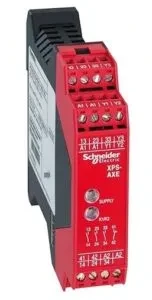
Schneider Electric XPSAXE5120P
What is a Preventa Safety Relay?
Safety relays are devices designed to protect people and equipment in automated industrial environments. They ensure a high level of safety for users and comply with the NF EN 954-1 standard. They are frequently used in industrial equipment to provide maximum protection for machines and operators.
Ubiquitous in industrial equipment, these components are intended to provide high protection for machines and operators. They comply with the NF EN 954-1 standard.
The NF EN 954-1 standard is a safety standard that establishes minimum requirements for the design, construction, and testing of machine safety devices. It applies to safety devices integrated into machines and separate safety devices intended for use with machines. The standard aims to ensure the safety of people and equipment during machine use and to avoid accidents due to malfunctions.
I have chosen the Preventa type XPS AC safety module (Schneider) for this presentation: wiring and operational testing. Note that safety modules from various brands exist, including: PILZ (pnoz3), OMRON (G9S), SIEMENS (Sirius). The wiring and operational logic are the same. Wiring examples are provided in each technical documentation.
Compact and easy to implement, this safety relay allows for the monitoring of an emergency stop chain or safety switches, with the possibility of automatic reset or manual intervention via a push button.
How does a Preventa module actually work?
Maintenance Tip: Once safety shutdown is performed by the Preventa module, learn how to diagnose your motors with our complete guide on three-phase motor testing.
In an emergency situation, we need an element, often in motion, to be stopped immediately. For example,
an electric gate. The power supply passes through relays; these relays are controlled by the Preventa.
The Preventa monitors emergency stops; if an emergency stop is activated or faulty, the Preventa stops powering the coils of the power contactors.
Imagine a machine equipped with at least one emergency stop. Here is the corresponding diagram:

- Terminals A1 and A2 power the module.
- S33, S34, and S359 are used for automatic reset or manual action. Wiring can be done between S33 and S34 or between S33 and S39 (reset upon release of the push button (falling edge).
- S11 and S12 are used for the emergency stop chain. The same applies to S21 and S22.
- 13, 14 and 23, 24 and 33, 34 are the output terminals of the module.
- ESC: External Start Conditions.
- S1, S2, S3 are the emergency stops.
In this example, if all emergency stops are not activated, they can be reset by pressing button S4. Relays K1 and K2 are energized, and their contacts 13-14 and 23-24 close, allowing relays K3 and K4 to be energized and authorizing the machine to operate safely.
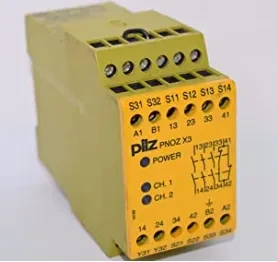
Buying a safety relay?
Here is a safety relay model from Pilz available on Amazon.
What is the role of a Preventa module?
The primary role of the Preventa module is to monitor safety functions within an industrial system. It allows for the safe interruption of power circuits upon detection of an anomaly or the activation of an emergency stop device.
Detailed Operation of a Safety Relay
A safety relay operates on the principle of redundancy and self-monitoring. Unlike a standard relay, it checks the integrity of its own contacts and connected peripherals (push buttons, light curtains) before authorizing the machine to start.
Comparison Table of Common Preventa Models
| Model | Main Application | Safety Level (SIL) |
|---|---|---|
| XPSAK | Emergency Stop and Curtains | SIL 3 |
| XPSAF | Simple Emergency Stop | SIL 2 |
| XPSU | Universal (New Range) | SIL 3 |
What is the role of a Preventa module?
The primary role of the Preventa module is to monitor safety functions within an industrial system. It allows for the safe interruption of power circuits upon detection of an anomaly or the activation of an emergency stop device.
Detailed Operation of a Safety Relay
A safety relay operates on the principle of redundancy and self-monitoring. Unlike a standard relay, it checks the integrity of its own contacts and connected peripherals (push buttons, light curtains) before authorizing the machine to start.
Comparison Table of Common Preventa Models
| Model | Main Application | Safety Level (SIL) |
|---|---|---|
| XPSAK | Emergency Stop and Curtains | SIL 3 |
| XPSAF | Simple Emergency Stop | SIL 2 |
| XPSU | Universal (New Range) | SIL 3 |


