Industrial Safety Sensors: The Best Solutions for Detecting Risks and Preventing Accidents
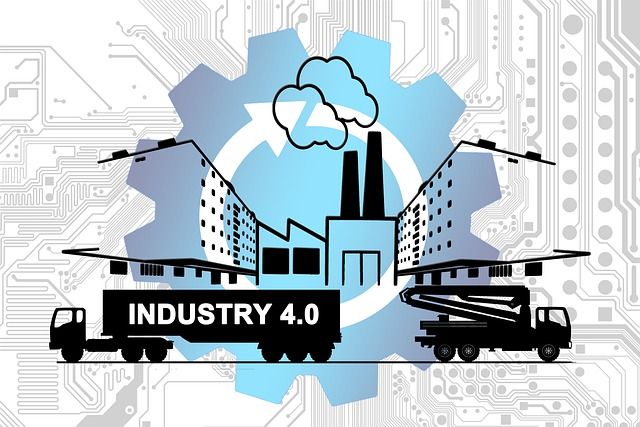
Safety sensors are devices designed to detect risks and prevent accidents in industrial environments. They allow for the monitoring of equipment and the work environment to ensure the safety of personnel and property.
According to data from the Directorate for Research, Studies, Assessment and Statistics (DREES) of the Ministry of Solidarity and Health, the number of deaths due to workplace accidents was 742 in 2018, down 4.8% compared to 2017. However, it should be noted that this figure does not take into account all accidents in industrial settings, but only those declared as such.
There are several types of safety sensors available on the market, adapted to different types of applications and working conditions. Common examples of safety sensors used in industrial environments include proximity sensors, pressure sensors, displacement sensors, and temperature sensors.
| Sensor Type | Brand | Product Reference |
|---|---|---|
| Proximity sensor | Balluff | BES 516-325-SA2-05 |
| Pressure sensor | ifm electronic | EDS 3448-3-0100 |
| Displacement sensor | SICK | WL12-3P2430 |
| Temperature sensor | Omron | E5CJ-R2M |
Proximity sensors are used to detect the presence of an object at a given distance. They are often used to monitor danger zones or to stop machinery in case of a problem. Pressure sensors measure the pressure exerted on an object or within a system. They are used to monitor dangerous pressures or to control production processes. Displacement sensors measure the movement of an object in space. They are used to monitor dangerous movements or to control production processes. Temperature sensors measure the temperature of an object or a medium. They are used to monitor dangerous temperatures or to con-
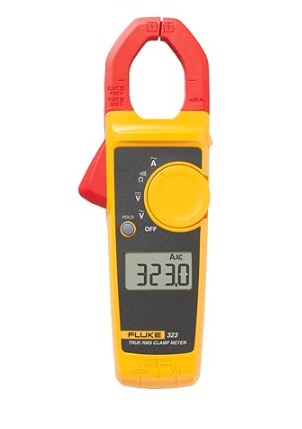
Fluke 323 Clamp Meter (True RMS, 400A AC)
🛠️ The essential tool for this project.
trol production processes.
The use of safety sensors in industrial environments offers numerous advantages. By monitoring equipment and the work environment in real time, safety sensors allow for risk detection and accident prevention. They can also improve equipment performance and production quality by reducing downtime and keeping equipment in good working order.
It is important to choose safety sensors adapted to your needs and equipment usage, taking into account the sensitivity, precision, and lifespan of the sensors. Do not hesitate to ask professionals or experienced users for advice to help you make your choice.
Here are some examples of safety sensors commonly used in industrial environments:
- Inductive proximity sensor: This sensor is used to detect the presence of a metallic object at a given distance. It is often used to monitor danger zones or to stop machinery in case of a problem.
- Differential pressure sensor: This sensor measures the pressure difference between two points in a system. It is used to monitor dangerous pressures or to control production processes.
- Linear displacement sensor: This sensor measures the movement of an object along a straight line. It is used to monitor dangerous movements or to control production processes.
- Infrared temperature sensor: This sensor measures the temperature of an object without physical contact. It is used to monitor dangerous temperatures or to control production processes.
In conclusion, the use of safety sensors in industrial environments is essential to ensure the safety of people and equipment. By detecting risks and preventing accidents, safety sensors can improve equipment performance and production quality. It is important to choose safety sensors adapted to your needs and to maintain them regularly to ensure optimal performance.