Ohm’s Law: Complete Guide and Interactive Calculator

Ohm’s Law: Everything You Need to Know to Start in Electricity
Summary: Ohm’s Law is the foundation of electricity. It establishes the fundamental relationship between voltage (V), current (I), and resistance (R) in a circuit. Mastering this law is essential for every electrician, from beginner to expert, in order to understand, analyze, and design electrical circuits safely. This article will guide you step-by-step with clear explanations, practical examples, and essential safety reminders.
⚡ Quick Answer
Ohm’s Law is the basis of electricity: V = R x I. It defines the relationship between voltage (V), resistance (R), and current (I). It is crucial for calculating the value of a protective resistor or understanding the consumption of an electronic circuit.
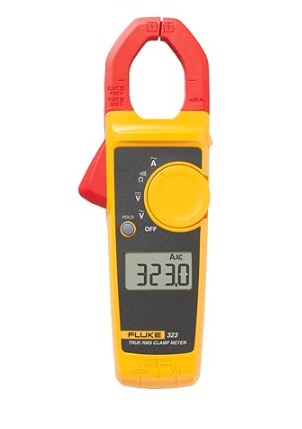
Fluke 323 Clamp Meter (True RMS, 400A AC)
🛠️ The essential tool for this project.
Introduction: The Basics of Electricity
Welcome to ElectroTuto.com! As electrical engineering experts, we know that a solid journey in the world of electricity begins with an unwavering understanding of fundamental principles. Among these, Ohm’s Law stands as the central pillar. Formulated by the German physicist Georg Simon Ohm, this law is not only historical but also absolutely relevant for the design, diagnosis, and repair of any electrical circuit, whether simple or complex.
Whether you are an electrical engineering student, a passionate DIYer, or a professional looking to refresh your knowledge, this article will provide you with the keys to demystifying the relationship between voltage, current, and resistance. Hang on, we are about to light your way!
The Three Pillars of Ohm’s Law: Voltage, Current, Resistance
Before diving into the magic formula, it is crucial to understand the three physical quantities it links.
Electrical Current (I)
- Definition: Electrical current (symbol I) represents the ordered flow of electrons through a conductor. Imagine it as the amount of water flowing through a pipe.
- Unit: The Ampere (A), in honor of André-Marie Ampère.
- Measurement: Measured with an ammeter, connected in series within the circuit.
Electrical Voltage (V)
- Definition: Electrical voltage (symbol V or U) is the difference in electrical potential between two points in a circuit. It is the “force” that pushes electrons to move. Using the water analogy: it is the water pressure in the pipe.
- Unit: The Volt (V), in honor of Alessandro Volta.
- Measurement: Measured with a voltmeter, connected in parallel across the component or source.
Electrical Resistance (R)
- Definition: Electrical resistance (symbol R) is the opposition that electrical current encounters when passing through a material. It “slows down” the electrons. In our water analogy, it is the narrowness of the pipe or the presence of sand.
- Unit: The Ohm (Ω), in honor of Georg Simon Ohm.
- Measurement: Measured with an ohmmeter, the circuit must absolutely be powered off and the component isolated.
The Magic Formula of Ohm’s Law: V = R x I
Ohm’s Law relates these three quantities in the following way:
V = R × I
- V: Voltage in Volts (V)
- R: Resistance in Ohms (Ω)
- I: Current in Amperes (A)
This basic formula can be rearranged to calculate any of the three quantities if the other two are known:
- To calculate voltage (V): V = R × I
- To calculate current (I): I = V / R
- To calculate resistance (R): R = V / I
A common mnemonic is the “Ohm’s Law Triangle,” where V is at the top, and R and I are at the bottom. Cover the quantity you want to calculate to find the formula!
Hydraulic Analogy: Visualizing Ohm’s Law
The water analogy is an excellent way to intuitively grasp Ohm’s Law:
- The generator (cell, battery) is comparable to a pump that creates pressure. This pressure is the voltage (V).
- The conductive wires are the pipes through which the water flows.
- The electrical current (I) is the water flow rate in the pipes. The wider the pipe, the higher the flow for the same pressure.
- The resistance (R) is the obstacle or narrowness of the pipe (e.g., a halfway closed valve, a filter, a thinner pipe). The greater the obstacle, the higher the pressure must be to maintain the same flow, or the flow decreases for the same pressure.
Thus, if you increase the pressure (voltage), the flow (current) will increase. If you restrict the pipe (increase resistance), the flow (current) will decrease for the same pressure. That is Ohm’s Law in action!
Practical Applications and Solved Examples
Let’s put what we’ve learned into practice with some concrete scenarios.
Example 1: Calculating Voltage (V)
An electric heater has a resistance of 20 Ohms (R = 20 Ω) and draws a current of 11 Amperes (I = 11 A). What is the mains voltage it is connected to?
V = R × I
V = 20 Ω × 11 A
V = 220 V
The heater is connected to a 220 Volt network, a standard voltage in Europe.
Example 2: Calculating Current (I)
A 12 Volt LED bulb (V = 12 V) has an internal resistance of 24 Ohms (R = 24 Ω). What current flows through it?
I = V / R
I = 12 V / 24 Ω
I = 0.5 A
This bulb consumes a current of 0.5 Amperes.
Example 3: Calculating Resistance (R)
An electric motor is powered by a voltage of 24 Volts (V = 24 V) and draws a current of 2 Amperes (I = 2 A). What is the motor’s internal resistance?
R = V / I
R = 24 V / 2 A
R = 12 Ω
The internal resistance of this motor is 12 Ohms.
Electrical Safety: An Absolute Priority!
WARNING: Electricity is dangerous and can be fatal!
Before any work on an electrical circuit, even a simple one, safety rules must be strictly followed. As ElectroTuto experts, we emphasize the following points:
- LOCKOUT/TAGOUT: This is the golden rule! Ensure the circuit is POWERED OFF before any manipulation. Switch off the main circuit breaker or the specific circuit breaker.
- Voltage Absence Verification: Always use a measuring device (tester, multimeter) to verify the absence of voltage on all phases and between phases and ground. Never rely solely on an indicator light or a switch.
- Personal Protective Equipment (PPE): Wear insulating gloves, safety goggles, non-conductive work clothes, and approved safety shoes.
- Never Work Alone: In case of an accident, another person can provide assistance or alert emergency services.
- Competence: If you are not sure of your skills, call a qualified professional. Never improvise with electricity.
Your safety and that of those around you come first!
Ohm’s Law Calculator
To make it easier for you and instantly put your knowledge into practice, we offer our interactive Ohm’s Law calculator. Enter two of the values (Voltage, Current, Resistance), and our tool will calculate the third for you.
Interactive Calculator
(The JavaScript code for this calculator will be integrated here.)
if (!isNaN(voltage) && !isNaN(current) && isNaN(resistance)) {
// Calculate Resistance
resultText = `R = ${voltage / current} Ω`;
} else if (!isNaN(voltage) && isNaN(current) && !isNaN(resistance)) {
// Calculate Current
resultText = `I = ${voltage / resistance} A`;
} else if (isNaN(voltage) && !isNaN(current) && !isNaN(resistance)) {
// Calculate Voltage
resultText = `V = ${current * resistance} V`;
} else {
resultText = ‘Please enter exactly two values.’;
}
document.getElementById(‘result’).innerText = resultText;
}
Beyond Ohm’s Law: Power and Energy
Ohm’s Law is an excellent starting point, but electricity is a vast field. To go further, you will also need to understand the concept of Electrical Power (P), which is the rate at which energy is consumed or produced. Power is calculated with the formula P = V × I (Power in Watts = Voltage in Volts × Current in Amperes). Combining Ohm’s Law and the power formula will give you a complete toolbox for most direct current (DC) calculations.
For alternating current (AC) circuits, things get a bit more complicated with the introduction of impedance and phase shifts, but the fundamental principles of Ohm’s Law remain the base.
Conclusion: Your First Step as an Expert
Congratulations! You now have a solid understanding of Ohm’s Law, the relationships between voltage, current, and resistance, and the paramount importance of electrical safety. This knowledge is your passport to deeper exploration of the fascinating world of electrical engineering.
Keep practicing with our calculator, exploring different types of circuits, and staying informed about the latest developments. At ElectroTuto.com, we are committed to providing you with the clearest and most comprehensive resources to help you become an autonomous and competent expert.
Feel free to ask your questions in the comments and share this article with other enthusiasts!
⚡ Ohm’s Law Calculator (V = R x I)
Leave the field you want to calculate blank.
Disclaimer: Theoretical indicative values.
Recommended article: How to wire and adjust a Variable Frequency Drive (VFD)?
Recommended article: VSFTPD: Install and Secure an FTP server on Linux (Complete Guide)
🧠 AI Selection: Related Topics (Vector RAG)
Our algorithm found these articles that share strong thematic proximity with your current reading:
- 🔗 Electrical Resistors: Significant Advancements (Affinity: 76%)
- 🔗 Electrical Capacitors: A Revolution in Energy Storage (Affinity: 75%)
- 🔗 Thermal Overload Relay: Diagram, Symbol, and Adjustment (Complete Guide 2026) (Affinity: 75%)