NF C 18-510: Mastering Electrical Lockout in 5 Golden Rules – Guide for BTS Students

NF C 18-510: Mastering Electrical Lockout in 5 Golden Rules – A Guide for BTS Students
Welcome to ElectroTuto.com, the reference for future electrotechnical experts!
⚡ Quick Answer
Electrical lockout (consignation), according to the NF C 18-510 standard, is a vital safety procedure to isolate an installation before intervention. It includes 5 mandatory steps: Separation, Locking, Identification, Voltage Absence Verification (VAV), and Earthing and Short-Circuiting (ESC) to guarantee the safety of workers.
You are in a BTS program, and you know that theory is nothing without rigorous practice. If there is one area where error is not permitted, it is electrical safety during “de-energized” interventions. The bible governing these interventions in France is the **NF C 18-510** standard.
In this article, we will break down together the most critical procedure for your safety: **Electrical Lockout**. Forget approximations. The standard imposes 5 sequential and non-negotiable steps, defined to ensure that no residual current or untimely restart puts your life in danger. Mastering this sequence means validating your technical expertise and professional maturity.
Industrial electricity is a dangerous field presenting risks of fatal electrocution, electric arc, and fire.
🚫 Any intervention, lockout maneuver, or troubleshooting on an industrial machine must imperatively be carried out by:
- Qualified personnel holding a valid electrical authorization (according to NF C 18-510 or equivalent local standard).
- OR persons undergoing training (students, apprentices) mandatory accompanied and actively supervised by experienced and duly qualified tutors.
Here is the ultimate guide to the 5 Golden Rules of Lockout according to NF C 18-510.
Lockout: An Unstoppable Sequence
Lockout is the safety operation that allows working on an electrical structure (or an industrial machine) by ensuring that all its active parts are separated from all their power sources, and that they cannot be accidentally re-energized. NF C 18-510 defines this precise order as mandatory.
1. Separation

The Action: This is the breaking of all electrical power sources from the target equipment. Technical BTS Nuance: This is an “omnipolar” cut-off (phases and neutral). You must use suitable breaking devices (isolators, circuit breakers, physical removal of fuses). The standard specifies that the cut-off must be visible or, if it is not, confirmed by a status signaling device or a voltage absence measurement (see step 4).
2. Locking

The Action: This is the mechanical locking of the separation devices in the open (OFF) position. Technical BTS Nuance: Locking physically prohibits the re-energization maneuver. You must use personal padlocks and a clear warning tag indicating the danger and the responsible person. This is your personal protection: one padlock per worker.
3. Identification

The Action: This is the on-site confirmation that you are going to intervene on the exact equipment that has been separated and locked. Technical BTS Nuance: This step is critical in complex environments (several similar machines, dense distribution cabinets). It is based on the installation’s signage, diagrams, and cable markers. Never assume; visually identify your safe work zone.
4. Voltage Absence Verification (VAV)

The Action: This is the ultimate safety measure before touching the equipment. This is the most important point. Technical BTS Nuance: The standard requires using a standardized Voltage Absence Tester (VAT) specifically tested before and after measurement (VAT self-test). VAV must be performed on all phases between each other, and between each phase and earth, as close as possible to the work site. A classic multimeter is not authorized by the standard for this action.
5. Earthing and Short-Circuiting (ESC)

The Action: This is the installation of devices to drain any residual energy or accidental fault current to the earth. Technical BTS Nuance: ESC is mandatory in High Voltage (HV). In Low Voltage (LV), it is strongly recommended by the standard, particularly for long cables, autonomous sources, or to guard against untimely re-energization from a third-party source. It must be carried out immediately after the VAV, as close as possible to the intervention point.
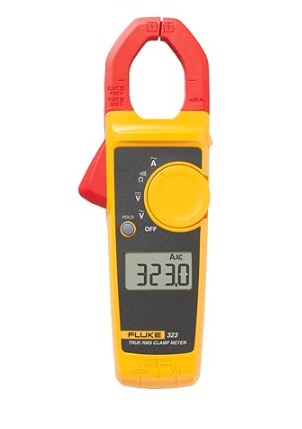
Fluke 323 Clamp Meter (True RMS, 400A AC)
🛠️ The essential tool for this project.
Conclusion
Future experts, remember this: NF C 18-510 is not a constraint; it is your armor. These 5 steps are not optional; they are inseparable. In BTS, your success is also measured by your ability to apply these rules in a fluid and professional manner. Working safely means first working with method.